
By SETH BORENSTEIN AP Science Writer
WASHINGTON (AP) — In the next five years, the Earth is overwhelmingly likely to surge again and again past the international climate threshold set as safe and shatter its hottest-year record along the way, according to new United Nations climate projections.
The World Meteorological Organization also forecasts an overheating Arctic that warms nearly 3 degrees Fahrenheit (1.66 degrees Celsius) between now and 2030 and a dangerous drought with potential wildfires for the Amazon, a crucial part of Earth’s natural defenses to lessen human-caused climate change. A hotter globe from the burning of coal, oil and gas means more extreme weather including floods, droughts and heat waves, scientists said.
The projections by the U.N. climate agency and the United Kingdom’s Meteorological Office said there’s a 75% chance that the average global temperature between 2026 and 2030 will be more than 1.5 degrees Celsius (2.7 degrees Fahrenheit) higher compared to pre-industrial times. That threshold is the agreed-upon limit of warming — averaged over 20 years — set in 2015 by the Paris climate agreement.
A U.N. science report a few years later detailed how exceeding that 1.5 mark means more likely death, danger and species loss. Even though it’s only a few tenths of a degree, some of the planet’s ecosystems, such as coral and glaciers, can’t handle the strain.
Passing warming limit has consequences, but no cliff
There’s a 91% chance that at least one of the next five years will shoot past the 1.5 degree threshold and an 86% chance that one of those years will smash the record for Earth’s hottest year set in 2024, the WMO report said. The WMO projects each year between now and 2030 to be between 1.3 degrees Celsius (2.3 degrees Fahrenheit) and 1.9 degrees Celsius (3.4 degrees Fahrenheit) since the late 1800s.
“It’s important to note that (1.5) is not kind of a cliff edge that we’re going to fall off,” said report co-author Melissa Seabrook, a climate scientist at the U.K. Meteorological Office. “Every kind of 0.1 of a degree has more and more severe impact.”
She pointed to unprecedented May heat in Europe this week.
An entire year or more above the 1.5 degree mark “means a whole range of extreme weather events, probably many so hot/wet/dry that it exceeds anything we’ve experienced in the past and thus crucially, anything our city planning, agriculture etc. has anticipated,” Imperial College of London climate scientist Friederike Otto, who wasn’t part of the report, said in an email. “This will mean many people will lose their lives, we are in for a lot of food price shocks, and more intense wildfires.”
Nearly all the shorter-term forecasts call for a strong El Nino — a natural warming of parts of the central Pacific that alters weather worldwide and spikes global temperatures — to form soon. The WMO report said it could stretch all the way to 2028. Because of that, Seabrook said 2027 will likely break the 2024 heat record.
And if the next five years do average more than 1.5 degrees Celsius since pre-industrial times, that means Earth will have warmed a quarter of a degree Celsius (0.45 degrees Fahrenheit) in a decade, which is faster than the previous rates of warming. Those were closer to two-tenths of a degree Celsius per decade.
Climate scientists are debating whether global warming is accelerating, “which obviously is quite scary,” and if these projections come true it would give additional evidence to those who see a speeded up rate of change, Seabrook said.
Accelerating warmth forecast in the Arctic
The projections, based on the averaging of about 200 runs of computer simulations using 13 different climate models from various countries, show warming in the Arctic rising 3.5 times faster than the rest of the globe, because there’s less ice and snow that had been reflecting solar radiation to space, Seabrook said. It becomes a vicious cycle.
“As the temperature warms, more sea ice melts, the worse this makes it,” Seabrook said.
Winters in the Arctic from 2020 to 2025 on average were 2.1 degrees Fahrenheit (1.2 degrees Celsius) warmer than the 1991-2020 average. The WMO projects the next five winters will average 5.1 degrees Fahrenheit (2.8 degrees Celsius) warmer than that recent normal, Seabrook said.
The report also forecasts Arctic sea ice to continue to shrink in the summer.
Amazon may get drier, sparking fire worries
The report calls for even warmer and unusually dry conditions in the Amazon basin, and that could be devastating for both local residents and the planet as a whole, Seabrook said.
People rely on the Amazon for water and the hotter, drier conditions should increase wildfire risk, Seabrook said, threatening to turn the Amazon, which now sucks heat-trapping carbon dioxide out of the atmosphere, into a region that worsens the problem.
Africa’s Sahel area, which has been extra dry, is likely to get more than normal rain and that could lead to flooding, Seabrook said.
United Nations officials said efforts to curb climate change haven’t been enough.
“Despite the progress of recent years, it’s clear that global heating is still outpacing global efforts to contain it, and the baking temperatures in Europe, India and elsewhere show yet again the brutal human and economic impacts of humanity still burning colossal amounts of coal, oil and gas,” U.N. climate chief Simon Stiell said about the WMO report.
“Whether it’s extreme heat, mega-storms, floods, massive wildfires or droughts hitting food supply and prices,” he said, “every nation is already paying a huge price from this global climate crisis.”
___
The Associated Press’ climate and environmental coverage receives financial support from multiple private foundations. AP is solely responsible for all content. Find AP’s standards for working with philanthropies, a list of supporters and funded coverage areas at AP.org.
News
Think it’s hot now? The next five years will smash records, UN says
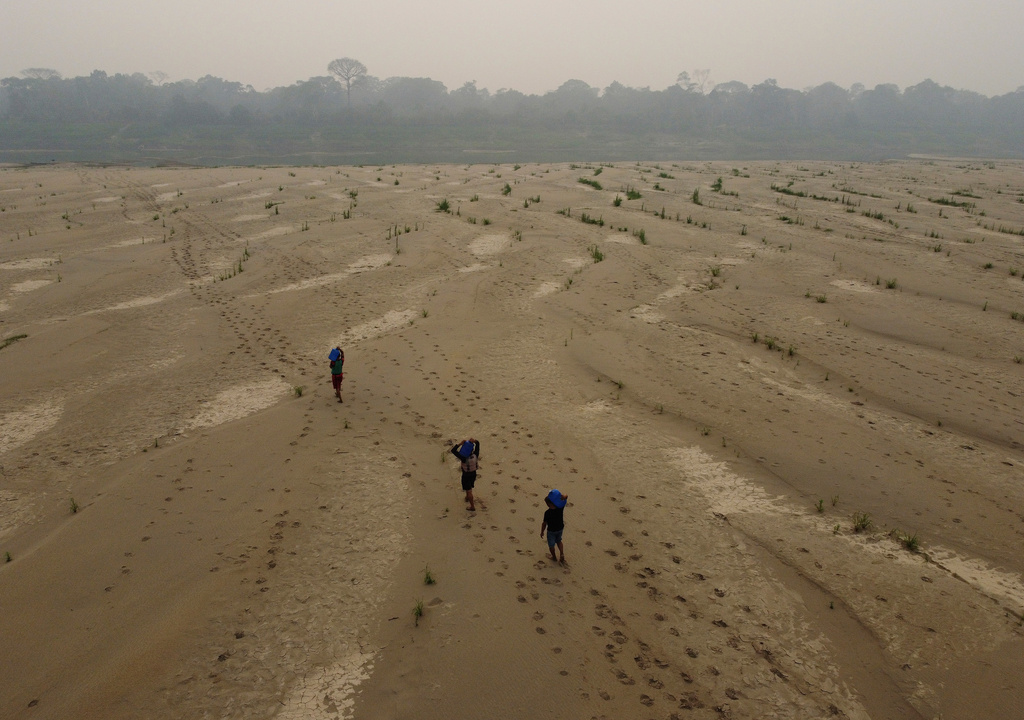
FILE - Residents transport drinking water from Humaita to the Paraizinho community, along the dry Madeira River, a tributary of the Amazon River, during the dry season, Amazonas state, Brazil, Sept. 8, 2024. (AP Photo/Edmar Barros, File) Photo: Associated Press